Wednesday, September 30, 2015

The man behind the barista: visiting a coffee grower in Peru

Shortly before leaving for my Kiva fellowship, I had an iced coffee so good that I thanked the barista.  Today, I got to thank the man who grew the beans--not the actual beans, probably, but the kind of high-quality beans that must have gone into such a drink.  Experts say that while Peru doesn't produce nearly the quantity of its famous neighbor, the quality of its coffee can be even better, in part because production is on such a small scale, mostly on tiny family farms.  Avelino Perez, 62, is one such small coffee farmer; he has taken out a Kiva loan of $325 to buy compost and fertilizer, and it's my job to check that everything's in order, and see how he and his business are doing.

Where the clouds come down to greet you
Perhaps it's fanciful to suppose that something delicious should come from somewhere beautiful, but Avelino's farm is the stuff wall calendars are made of, tucked away in heaving mountains shrouded in mist and lush with vegetation.  From Pucará, a mere hamlet two days north of Lima, it takes three hair-raising hours on a motorcycle to reach him.  I've hiked trails that were in better condition than this road.  Ebert, the loan officer, and I pass small waterfalls and huge, panoramic vistas.  We pull over for trucks, women with babies on their backs, and men in enormous hats with machetes slung over their shoulders.  We stop often for directions and still find ourselves puzzling over which scratch in the dirt to follow.

Avelino's house on a hill
 We're greeted by Avelino's son, who says his father is out in the fields, pointing to a black spot I can barely make out a couple ridges down.  When we explain that we've come a long way to see Avelino, the son and Avelino's wife and a daughter and grandson send out a bucket brigade of shouts urging him to come in.

Appearing much more quickly than I would have thought, Avelino is flattered to have a visitor from Pucará, let alone the United States.  This is my third borrower visit, but the process continues to remind me of the famous scene in The Wizard of Oz when the film jumps from black and white to color, as this person who was just a face on an Internet page appears live before me.  He readily agrees to be photographed, and urges his daughters to pose as well, but they are shy and wary.  He is a man of expansive gestures and simple words.  His biggest concern seems to be that we might catch cold from the wind (delightfully cool to me after the swelter of Pucará, in the desert plain thousands of feet below); he continuously urges us to rest "inside," by which he means closer to the doorway of his adobe brick house, farther in under the corrugated tin roof, away from the dangling laundry.

Proud papa of profitable plants
I ask if we can see some of his plantings, and he happily leads us down the steep hillside thick with the short, dark-leaved trees that spawn the magic beans.
"Growing coffee must be very hard," I offer.
"No, it's easy," he says.
His weathered hands suggest otherwise.
"What's the hardest part?" I persist.
"Preparing the ground is difficult," he allows.  "After that, all is easy."
People in northern Peru have been teased for "singing" their Spanish, and country folk do so even more than city people.  The way Avelino says "easy" is the auditory equivalent of a first baseman lobbing a practice throw to home plate: indolently expressive.

I ask if he has any dreams, what more he'd like to do with another loan, but he seems baffled by the question.  "Improve your house, send your children to school, perhaps?" I suggest.  "Yes, yes, these things are very important," he agrees.  "Pay medical expenses also."  I often have to chide students away from the "poor but happy" stereotype of college essays, so I don't want to romanticize this man who spends his days in backbreaking labor.  But there is something refreshingly "grounded" about him, and I realize that the reason he has trouble talking about dreams is that his are essentially the same as everyone's.  Some of us chase dreams in business, or firefighting, or sales, or medicine, or teaching--he pursues them with coffee.

Experienced hands make tasty coffee
Though I fancy myself a connoisseur of coffee, and I've visited both plantations and processing plants before, I learn things from Avelino.  Ripe coffee "cherries" are sweet, but unripe ones are tasteless.  Not all ripe berries are red; he has one variety that ripens yellow.  Most plants mature at the same time, but not all: within a few feet are some whose "cherries" have desiccated into husks, while others are still flowering.

I ask Avelino how much a kilo of coffee sells for: 2 or 3 soles, he says (less than a dollar).  I'm almost afraid to tell him that in the US a kilo of good coffee can cost twenty times that or more.  "Coffee is the best crop for Peruvians," he insists.  Even though he sacrifices most of the profits to distributors and processors, he still nets far more than he would with such common, low-margin crops as corn, beans, or potatoes--which he grows in small quantities for his family, as well as keeping chickens and pigs and a cow or two.  He's very proud of his several hectares of coffee, but not too proud to be a subsistence farmer on the side.
The women of the family consent to a portrait

The burning question for me is, does he drink his own coffee?  Yes, he says, he has his own machine for husking the beans as well as a wooden toaster, but it's the wrong season for that now.  Thus my hopes of tasting coffee in the spot where it's grown are dashed--and not for the first time.  One of the many ironies of the coffee industry is that the beverage is almost never available anywhere near the plant, because the processing is almost all done in North America and Europe, even though cultivation is exclusive to the tropics.

Avelino is surprised when I tell him that we don't grow coffee in the United States.
"Too cold," I say.
"Aaahhh, it gets cold here too," he says.
"Do you get snow?" I ask.
"Noooo.  A sprinkling in the sky, maybe.  Nothing on the ground."
"Where I come from in winter the ground is covered in ice and snow."
"So cold!?" he says, almost skeptically.  "My plants would not like that."


Night falls fast this close to the equator; dreading the long, breathtaking, butt-pounding ride home, I suggest that maybe, regrettably, it's time to go, thanking Avelino profusely for letting me pester him with questions and photos.  Yet the funny thing is, in the end he thanks me.

You can say "thanks" to Avelino and other small-scale farmers by making a Kiva loan of your own at http://www.kiva.org.  To support others in Avelino's area, and the microfinance organization where I'm working (Edpyme Alternativa, Chiclayo, Peru), click here.


Friday, September 4, 2015

Dogs and beer


For the last week I've been training to be a Kiva Fellow at Kiva headquarters in San Francisco.  There's a lot to be said about Kiva, and its Fellows program, but for now I want to focus on their office, which validates many of the seemingly outlandish claims I'd heard about Silicon Valley work environments being more like Montessori classrooms than offices.  Coming as I do from a tradition-bound Anglophillic prep school, this is both shocking and refreshing.

There are no walls--at least no permanent ones.  The large, high-ceilinged workspace, with exposed heating ducts, concrete floors, and an "industrial" aesthetic, creates subdivisions only with sliding doors, curved plywood partial partitions, desks and other furniture, and shower curtains.  Given that some 100 people are intently manning computer workstations and collaborating in various sub-groups, the noise level is surprisingly low.

Flexible seating


There are no individual desks.  People seem to have designated spots, but they're all at common tables shared by six or more co-workers, and people move around a lot, from big low rectangular tables to big high rectangular tables to small round high tables to small round low tables to couches to stools to chairs to Yoga balls.
The revolution will not be leashed

If there's any hierarchy, I can't see it.  Regional managers, who are pretty close to the top of the Kiva "food chain," sit next to interns, and Fellows, mere volunteers, are allowed to wander at will.  The corporate counsel, a tall, bright-faced woman of barely 30, looks more like an elementary school teacher than a lawyer.  The CEO, a rail-thin Swiss man of maybe 50, wears sneakers, jeans, and a button-down shirt, and could hardly be more self-effacing or casual.

Dogs are welcome; one cinnamon-pelted husky-heavy mutt wanders the office most days in search of willing Fetch partners or head-scratchers.

Let my people drink!
Both a keg and a dedicated beer fridge grace the closest thing to an auditorium, a semicircle of chairs facing a pull-down projection screen with a pair of incongruously old-school Klipsch speakers hooked up to wireless mikes and a giant computer monitor.  People wirelessly plug and unplug their laptops to this and any of several other oversized monitors whenever the need arises.  Macs and PCs, desktops and laptops, are all happily married.  Outlets are everywhere; a cluster of every known phone charging cable pokes through a hole in one of the lunch tables.

The kitchen would not satisfy a compulsive cleaner, but food is shared and dishes attended to with reasonable alacrity and thoroughness without any apparent supervision.  Though lunch becomes a lively social hour, eating at your desk, or in a small working group, is not uncommon.
Fussball, anyone?

Dress is very casual: on Monday, the president gave the closest we've come to a formal talk in jeans and a sport shirt, tails untucked.  The next day he sat down at lunch with whoever happened to be around.

The closest anything comes to a private room is an enclosure with one glass wall and a sliding door.  The only space without a glass wall is the "quiet work area," whose door never closes; looking a lot like an old-fashioned library, it features a life-size statue of Yoda.


May the force of innovation be with you


At the far opposite end of the space is a hammock room.
How's it hangin'?

About midway between is "Thunderdome," the largest discrete space apart from the "auditorium," where, in case the giant monitor proves inadequate, the long internal wall, painted green, can be written on like a whiteboard.

Don't fence me in

Kiva staffers seem universally peppy, and private conversations have confirmed that while the pay is low, work conditions are commensurately low-key.  Nonetheless, I can't believe that all this casualness comes without a price: 40 hours a week in front of a computer screen has a strong taint of drudgery, no matter how you package it, and nonprofits can be just as exploitative, in their own way, as any soulless corporation.  Being noise-averse, and working best alone, I might struggle to be productive or happy at Kiva.  Still, I wonder, if Kiva can accomplish so much with dogs and beer, why do the rest of us persist with neckties and closed doors?  Is it possible for work to be too cozy?


Rainbow of ideas


Tuesday, April 7, 2015

How to eat radishes

Nothing says spring like these beauties
On a hike in Guatemala once I passed a farmer with a huge bunch of radishes slung over his shoulder almost like a slain deer.  They were big and round and that luminous shade of perfect red, black volcanic dirt still clinging to their little white tails.  Impressive as the harvest was, I was a bit surprised that a subsistence farmer would bother growing them, since they seem to have virtually no caloric value, little flavor (this mild French variety, at least), and few specific uses that I could think of.  In short, I've never understood radishes--you can't really cook them, and there's not that much to be done with them raw.  When I was a kid my mom would serve them, topped and tailed, on a saucer with a well of salt in the middle.  Dipping the moist radishes in the salt was kind of exciting, especially since we normally followed a minimal sodium diet.  But this was more a curiosity than a meal.  Later I learned that the French, who have a knack for finding the simplest and best way to use most any ingredient, eat them with nothing more than a smear of butter (sweet butter, presumably).  This is delicious, of course, but it rather strains the imagination to think of something that wouldn't taste good slathered in butter.

Getting a-head of myself?
In seemingly unrelated news (spoiler alert--not unrelated by the end), three years ago the farmers' market was practically giving away pigs' heads ($5, well, a head).  I bought one and scoured the Internet for advice on what to do with the damn thing, settling fairly quickly on a recipe for porchetta di testa (head cheese, loosely) by Chris Cosentino:


It felt more like a high school science project than a recipe at first, but in the end the whole process was a lot easier than I would have thought.  My pig's head came ear-less and tongue-less, so I didn't bother cleaning it with anything more than water.  Wary of getting into things like vacuum bags, I simply steamed it on a cookie rack in a big pot, adding water periodically until it was fork-tender after 3-4 hours.  I arranged slices on a platter with lemon wedges, capers, and radishes, and brought it to a holiday party as an appetizer.  I kept apologizing for bringing something so weird, but everyone tried it and loved it.  I still had plenty left over to share with family over Christmas vacation.  Being ardent fans of traditional German head cheese, they were duly taken with this Italianesque version.  With the de-meated skull I made pozole, the rich Mexican soup of giant white corn, red chilies, and--you guessed it--pig's head.

The meat "butterflied" from the skull
A week ago pig's heads once again came into "season" at the farmers' market, as the family pork butchers clear out their meat to make way for plants and eventually vegetables.  The price had gone up to $10 a head--I neglected to weigh mine, but that must work out to well under $1 a pound.  Recoil at the gruesomeness if you will, but I defy anyone to get more nutrition and flavor for anywhere near that price.  Between the head cheese and pozole, one pig's head easily generates a full week's meals.  I was eager to repeat the recipe I'd used three years ago, but I wanted to come up with a better way of cooking the rolled meat--steaming had left it rather grayish and a bit bland.  The oven, I was afraid, would leave it far too tough.  Then it hit me: why not put it in the charcoal-powered vapor smoker I'd picked up a couple years ago for almost nothing at a rummage sale and was always looking to get more use out of?

Loaded with rosemary, garlic, lemon rind, and fennel
Pink, tender, juicy, and aromatic
In a sense, this was the most successful smoker project ever: I loaded the machine with charcoal, soaked hickory chips, and turned cider, put the rolled head in, patiently waited and waited and waited, fighting the urge to open it up and lose precious heat but clueless as to how well it was cooking, since it was too tough even to prick with a thermometer.  About six hours later, it was dark and the fire was dying, so I stuck a long fork into the meat and, to my amazement, it was tender as a canned ham.  A thermometer probe confirmed 160 all the way through, safe to eat.  Every other time I've used the smoker I've run out of charcoal or light or both before whatever meat I'm working on is done.

This time the meat was pink and richly redolent of smoke--legitimately comparable to prosciutto, or salami.  I "plated" it on a bed of the first arugula of the season, and garnished it with capers and thinly sliced lemon.  The skin remained incredibly tough (hard to slice, even), but other than that it was an orgy of tantalizing textures and richly nuanced flavors--in short, a singular appetizer.  But as I was munching on it, I had a strange thought:

I missed the radishes.  

Eye-catching and mouth-watering
Three years ago I'd made the head cheese in December, and I still had some radishes kicking around in the fridge from the last harvest before Thanksgiving (they keep remarkably well).  They were a little tired, but they were ineffably perfect with the head cheese.  But this year I was much too late for last year's radishes and not quite late enough for this year's.  Yet their lightness and moistness and crunch and delicacy and blandness go so well with this dish.  Strange as it sounds, the best way to eat radishes is with a pig's head.


All that's left of This Little Piggy


Thursday, December 4, 2014

Sharpening the senses

Like approximately half the American population, apparently, I've been taking yoga classes.  Although I look "hippie" enough to be commonly mistaken for an art student or Kinko's employee, this does not mean that I'm anywhere close to guru-hood.  Apart from a love of tea and one trip to India, I'm pretty far from a poster-boy for all things meditative or Eastern.  I signed up for this class mainly because it's offered at work, and thus almost too convenient to refuse.  This is not the first time I've tried yoga, and in some sense it's a miracle that I'm back at it, given that I'm blessed with possibly the tightest hamstrings in the world, and a basic metabolism so high that I sweat profusely even during non-"hot" yoga--not to mention that I don't even own a pair of sweatpants.  And while I'm a pretty low-key fellow generally, I'm enough of an insomniac and mind-racer that "shavasana," the corpse-like semi-sleeping pose that every practice ends with, which most consider a kind of recompense for all the contortions leading up to it, brings back unpleasant memories of nap time in pre-school, at which I consistently failed.

Yet I persist, in part because of the teacher, who tantalizingly both reinforces and conflates all my stereotypes.  Neither a gym teacher nor a flower child, the two basic camps into which most instructors seem to fall, she looks and comports herself a lot like an aging trophy wife--an unusually common demographic around here.  Can a yoga teacher drive a Cadillac SUV, wear huge hoop earrings, and be always perfectly coiffed and made up?  She employs much of the oddly vague jargon I've heard from other yoga teachers, like "side-bodies" and "sitting-bones," and she has occasionally read a cringe-inducing "everything-is-wonderful" sort of poem, or played faux-Gregorian chant with lyrics like "Creation is awakened" straight out of a Solidarity Service from Brave New World.  But she rarely talks, she rarely touches anyone, and she manages to make each practice subtly different from, and slightly harder than, the last.

Some time ago she mentioned that the changing seasons always presented a good opportunity to do a purge.  Fortunately, she was not talking about barfing teenage girls, or high colonics, or trips to the Salvation Army, but rather a week-long diet in which you eschew alcohol, caffeine, sugar, meat, gluten, and dairy--all the good stuff, basically.  The point is not to lose weight so much as to clear the body and mind, a biological "reset" of sorts.  The most extreme form of purge would be to eat nothing but brown rice and mung beans for a week--which she'd tried--but even giving up one of the six things was a start.  You should be prepared for a crash after the first day or two, but after that you should start to notice increased energy, clearer thinking, and awakened senses.

Post-Thanksgiving seemed like the perfect time to try this.  In fact I'd dipped my toe in the purgatorial waters once before, last spring, but hadn't dared relinquish caffeine (or dairy).  This time I decided to avoid everything except dairy (mainly to preserve my breakfast routine of yogurt with fruit).  Coincidentally, this means I'd essentially be adopting the same diet as a pregnant colleague, with whom I've been joking about the ever-lengthening list of foods that our own pregnant mothers ate freely yet are now considered shameful for anyone in a family way.  Long-time readers may know that I'm generally very much opposed to the recent vilification of dairy and gluten that's become all the rage among so many half-hearted health enthusiasts.  My ancestors did quite well on all manner of dairy- and gluten-rich products, thank you very much, and I see no reason to forgo yogurt or whole-wheat bread in favor of soy lattes and rice-flour chocolate chip muffins.  But I also realize that nearly all junk food is based in bleached flour, refined sugar, and hydrogenated oil, and even though I eat very little of this stuff normally, it might be interesting to see how things changed if I eliminated not only bagels and cookies, but pasta and bread too.  Forever, no, but for the sake of contrast, yes.

By day three of the dietary challenge the most remarkable thing was how much more I was eating, and how much of it was fresh fruits and vegetables.  Even with dairy still on the table (pun intended), and even though I'm not a huge carnivore, a lot of calories are locked up in meat, gluten, sugar, and even alcohol.  The combination of the purge with my general locavorism has made assembling dinner feel a bit like an Iron Chef challenge.  It's easy to be a vegetarian in the summer; not so much in Michigan winter.  Go-to flavoring agents like bacon are off the table, as are standard bases like linguine.  Yet last night I managed, almost despite myself, a meal which reminded me of that simple yet confrontational claim I'd read decades ago in Diet for a Small Planet: "the vast variety of colors, flavors, and textures comes from the plant world, yet the average American restaurant would give you no clue to this fact."  My cobbled-together menu was both a celebration of fall and a jostling reminder of how much excitement and diversity can be packed into a simple meal when it focuses on vegetables:


  • Brussels sprouts with chestnuts braised in butter, served with shaved Parmesan
  • Eggplant baked in thin slices, tossed with olive oil, garlic, rosemary, and lemon juice
  • Spicy mixed pickle of red and green chilies, onion, carrot, celery, garlic, olive oil
  • Apple cider (unpasteurized)

Not much to it, really, but so much going on as you eat it: big, round, hard, bright green Brussels sprouts, slick on the surface from melted butter but wrinkled and layered like the mini cabbages they are on the inside; little dark brown hemispherical chestnuts with their unmistakable woody flavor and crumbly, slightly mealy texture; papery and buttery Parmesan crumbling on the fork or tongue; darkly colored pickled vegetables slathering fire over everything; limp yellowish eggplant slices folded over themselves, purple still showing in their almost rubbery skins; bright, sharp lemon juice; spicy, chewy, amorphous garlic bits; prickly, needle-shaped, white-and-dark-green rosemary redolent of pine groves; freshly ground salt and pepper more than an afterthought.

Shelf-stable, ready-to-eat chestnuts
from the Chinese market
Homemade pebre, a spicy mixed pickle
like those in Salvadoran shops


I can't say I've approached nirvana on this diet; my thinking hasn't cleared significantly, nor has the usual slump in energy I feel several times a day disappeared.  Whether from too much or too little caffeine or alcohol, I often get mild headaches according to no predictable pattern while on my normal diet; so far I haven't had any this week.  But if these food restrictions give me nothing more than a renewed sensitivity to the material world, whether in food or elsewhere, that will be no mean feat.  Who among us hasn't felt a certain deadening or numbing with the passing of seasons and years, and longed to be jostled--even if a bit violently--back awake?


Tuesday, June 24, 2014

Car shopping

This winter in Michigan was so hard even the cars died--or so did my beloved blue Mazda3 that I'd bought with 1 year and 20,000 miles on it ten years ago in NJ.  It was nearly the perfect car, and it had been the perfect car-buying experience: I found it online, test-drove it, liked it, made a low but firm offer, and traded in my Nissan Sentra SE-R for it all in one fell swoop.  I knew I was lucky to find a stick shift in a nice color with reasonable options in mint condition--even as I was driving it, the salesman was incredulous: "You understand this car is a manual?"  When they tried to play games with the price, I said, "Well, I don't have to buy a car today," which was true--my little Nissan was old and a bit beat-up, but it was fun as hell, and my favorite color (red) to boot--and eventually they caved.  Braving the NJ DMV to title and register a not-quite-new car knowing I would just have to do it all over again a few days later in MI wasn't fun,  but the DMV was light-years ahead of the Ellis Island-like purgatory I remembered from high school.  At the risk of playing misery poker, I have to stop Michiganders every time they complain about the DMV--or "Secretary of State," which are clean, well-lit places staffed by friendly, helpful people.  When Kurtz mutters "The horror, the horror!" he could well be talking about the NJ DMV of yore, where they had a line you had to wait in just to figure out which line to wait in.

Can a car have a nice ass?
Reminiscent of a Beetle or 911: curves in all the right places.
The perfect blue:
unmistakable even buried.
Easy to clean.
Bye-bye, baby!
I've been in a kind of mourning ever since late January, when Li'l Blue went to automotive heaven after abruptly running out of oil, locking up the engine for good.  My mechanic blamed the "oil-sending device," some mysterious mechanism deep within the engine, but I wondered if the drip-pan had ruptured on some super-frozen ice protruding from the road: there was enough oil spilled to seep through the snow in the driveway--by March a substantial stain was visible--and this was the Polar Vortex, after all.  I would need a new engine for more than $3000--almost exactly the Blue Book value.  No 10-year-old car is worth that.
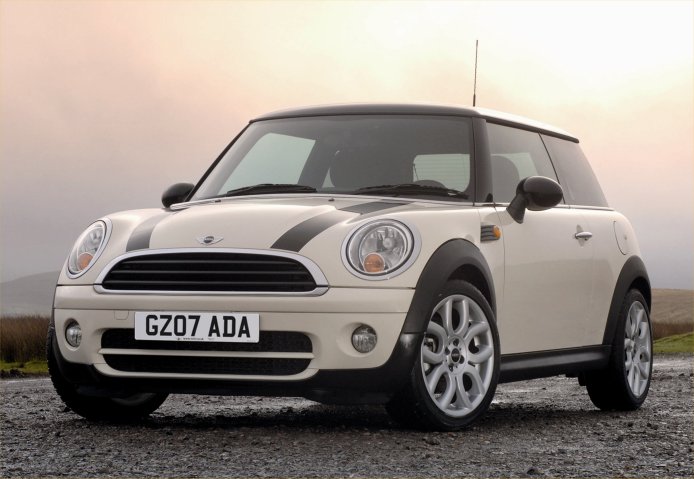
MINI Cooper S "Hardtop":
I wish they all could be British Racing Green...
MINI Countryman:
A scaled-down Honda Element?
Friday I finally bit the bullet and started going for test drives.  Fortunately, the salesmen haven't been nearly as slimy as I feared.  I started at the MINI dealer, where a friendly, low-key, Lebanese-looking fellow let me take out both the four-door "Countryman" and two-dar original "Hardtop" by myself.  At the end he gave me a bottle of water, offered to let me come back and drive some more anytime, and let me go on my way without any pressure whatsoever.  Classy!  But I was surprised by how little I was taken with the cars.  They’re undeniably zippy, and reasonably roomy, but they felt cheap, which is odd given that they’re made by BMW.  Little things like turn signals not moving as smoothly as I’ve come to expect, radio knobs being too small and hard to turn, dash and other materials being too rubbery or plasticky.  And the newest ones are moving away from some of the throwbacks to the original Mini, like a center-mounted speedometer, in favor—like frightfully many cars now—of a giant digital “infotainment” display in its place.  More intangibly, they’re just silly, like giant toys.  Some details are endearing, like metal pedals, but most seem to be trying much too hard for the “go-kart” feel their owners for some reason crave: very stiff ride, jumpy steering, light, rubbery clutch, arcade game-like gearshift.  They did drive very well: super-grippy around corners and able to pull or pass in all six gears.  But the real winner of the visit was a vintage Morris Mini they had, with an elegantly simple dashboard, and matching pistachio interior and exterior, the likes of which you can't get today at any price.
Original Mini interior:
How far we've fallen since the '60s...

Today I hit the Fiat dealer.  I don't know how Fiat is doing elsewhere, but in my super-affluent and car-crazed zip code, they're the next big thing--two new dealers have sprung up within five miles.  I tried the 4-door 500L, which I'd read is actually based on a totally different platform from the self-consciously retro 2-door.  It feels--and looks--like a scaled-down bread truck: its boxiness gives amazing headroom, and an unusually impressive cargo capacity, made more useful by seats that fold six ways from Sunday.  It's a pleasant interior--at least in the upscale Trekker--featuring two-tone seats, an attractive old-school dash, and an obvious but not overbearing computer screen.  I've never driven a Jeep Cherokee or other small SUV, but I imagine they feel a lot like this: despite decent pep and a smooth shifter, it is very far from sporty.  The neo-classic two-door may be a little too true to its roots: a dash-mounted manual gearshift is just too much for me, even if it worked well enough.  The tachometer inside the speedo--or was it vice versa--was pretty, but hard to decipher.  But it is very stylish overall, especially the interior accents color-coded to the body (reminiscent of the vintage Mini above).  The salesgirl--who didn't look a day over her 21 years, and had a lot more pep than the cars themselves--touted the "Abart" extra-sporty model as being really fast and fun; I'll take her word for it, but it would take a lot to overcome the basic econobox feel of any of their models.  Cassandra was certainly the most fun salesperson I've had in a while, but I'm not nearly enough of a multitasker to drive, observe, chat, and make nice simultaneously.  But I give Fiat credit for being unabashedly different: a friend dismisses them as "clown cars," but I would say they're as close as anyone will get to a 4-wheel Vespa, or an espresso machine on wheels.
Fiat 500: Cute to a fault.
Fiat 500L: Beach Boys staff car?
Next stop: VW, where I told the understated, middle-aged saleslady I was interested in a Jetta Sportwagen or Golf, preferably in diesel, and she promptly determined that they were fresh out of either one.  "Not to make your job harder," I said, as she took down my contact info and promised to do her best to procure one for me to test, "but it really needs to be a manual."  This obviously was not going to help matters, despite VW's posturing as the frugal enthusiast's car, and every dealer I visited insisting manuals are on the rise.  Nonetheless, she dutifully asked about my preferences in "trim lines," which VW is mercifully simplistic with as far as I can tell, to which I countered that color is probably more important than sunroof or navigation system.  Trouble is, VW seems to use its Teutonic heritage as an excuse to spurn all but the most boring colors: they come in what seems like twelve shades of white-silver-grey-tan, and if you're really lucky, an overcharged red or dull blue.  This is especially unfortunate given that they're some of the most boring-looking cars out there to begin with.  Few seem to remember that in the early '90s they had a beautiful metallic blue-green.  Apparently most people pay far less attention to color in a car than I do--or else I'm the only one who favors interesting colors.  But it's more than trivial: never once did I have trouble spotting Li'l Blue in a parking lot, and it lifted my spirits every time my eyes fell on her from my window or the street.  Colors notwithstanding, I was expecting to be impressed, maybe even seduced, by VW, but instead I had the very odd-seeming experience of walking into a car dealer, money in hand so to speak, and being sent packing.
VW Golf:
Peugeot makes a much handsomer li'l hatch in Europe.

VW Jetta Sportwagen: Not an eyesore, but hardly sexy.


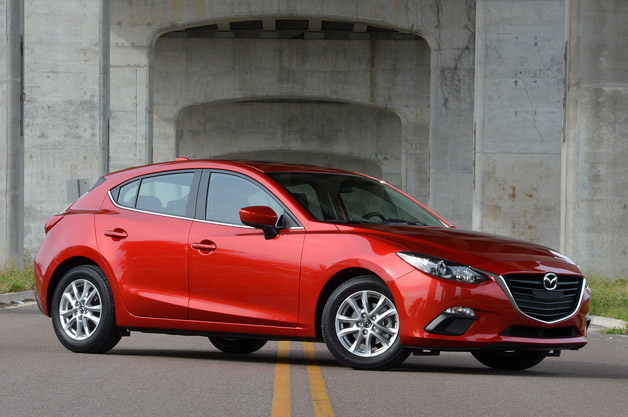
The Mazda dealer is basically next door to the VW dealer--and virtually every other brand imaginable, part of a sprawling "Motor Mall."  It was raining, so I drove from one to the next, which felt silly, but heck, if I'm potentially shelling out $20 or $30,000, I should get the VIP spot, right?  They were busy, and I almost had to ask for help.  The first guy who approached me was very young and didn't seem to know what to do with me, neither shaking my hand nor offering me a seat, so that I stood awkwardly in his cubicle while he sought advice from higher authority.  I'd already checked my email and the weather several times before an older, more with-it guy confirmed that they didn't have any Mazda3 manuals ready, even though one had "literally" just come off the truck but wasn't "prepped" yet (is this a racehorse?).  So I took out an automatic--a stripper "sport" model, it turned out, one of a dizzying array of trim levels and options.  Curiously, they didn't even ask for my license, just handed me the keys and let me drive off alone.  This felt like a real car--for better and worse--compared to the MINIs and Fiats, and, not surprisingly, a lot like Li'l Blue.  A bit sluggish, but very taut and solid.  The interior was pretty stark for my taste; so much black, and so little light or color, that I found it hard to read the heating controls, and the tiny digital gauges for everything except speedo were pretty awful.  Still, much the same endearing poshness I remember: the cohesion and quality of the interior suggests a much more expensive car.  Li'l Blue featured such little elegances as a six-point steering wheel design that echoed the giant alloy wheels and tail lights.  The new one's not quite that artsy, but it's a lot less random than a lot of cars.  I forgot to check the visors on the test car; on my first major drive with Li'l Blue, I fumbled at the tollbooth on the OH Turnpike with my ticket, until I opened the visor and found that there was a clip built in to the back of the mirror.  "That," I thought, "is why we're losing to the Japanese."  It's frightfully hard to tell how any car drives in suburban Detroit, where there are essentially no curves and no hills.  Oddly, I found myself seeking out potholes, of which we have plenty, to test the ride of the various cars.  All were on the taut side--as was Li'l Blue--which made me wonder how much of what we like in a new car, or eventually tire of in an old one, is simply age and wear.

The new Mazda3:
Even though they feature "soul red" in all the brochure shots, it costs $300 extra.
I thought that kind on silliness died with the Model T.


Make way for goslings!

On the way home my frustrations with capitalism were temporarily quelled by the adorable scene above, straight out of Robert McCloskey.  The plumbing van behind me was in a terrible hurry, preventing me from getting a better shot.  This brought me back to my grumblings: American consumerism is brilliant at delivering whatever happens to be available, or deemed appropriate by some unseen force, but it can be remarkably bad at letting you get exactly what you want.  Every dealer gave me, or suggested that I should be interested in, a list of cars on their lot.  Why should I care about their inventory problems?  If I'm going to shell out for a new car, I want it my way.  Doesn't even Burger King offer such customization--and speed?  Instead of agonizing over the merits of four or five cars as cars--the problem I expected--I'm left worrying over which might be available when and in what configuration.  It's been a fun process--as much for the people and setups as the cars--but I'd like to be able to end it on my timetable.


Tuesday, August 20, 2013

Getting under Maputo's skin

Fresh OJ and cake
A lot of people were surprised that with nearly a week in Mozambique, I "only" planned to visit Maputo.  I'll admit to a certain laziness: it took a lot out of me to plan my four weeks in South Africa, and by the time it was all settled, I was in no mood to hash out a bunch more details for the final week.  But mainly it was a calculated move: while travelling obviously centers on movement, some of the best experiences come from staying in one place for a little while.  Major cities particularly lend themselves to slow exploration.  It takes several days for any interesting city to begin to reveal its secrets, and some of my favorite adventures abroad have involved simply sitting still in various big cities.  I spent almost a week in Buenos Aires, but when people ask me what I did, all I can say is "have lunch."  Italian and Spanish influences there mean that "lunch" is typically a two- or three-hour affair involving wine, multiple courses, coffee, and long conversations.   I happened to arrive the day the president resigned in an almost-coup, causing people to linger even longer over their gnocchi and Malbec.  I would go into small, dark, smoky restaurants and just listen and learn.  I had enough Spanish to stay in the conversation, and enough obvious foreigner-ness to be welcome and indulged.

Watching the world go by
Every city has a trick, a secret strategy revealed only to natives or attentive visitors, a specialty that makes it bearable and fun.  In New York it's the subway.  In Paris, bakeries.  In Rio, cold beer and buffets.  In Detroit, free parking.  In Moscow, snack kiosks.  Maputo, it turns out, is one of the world's great places for street side cafes.  This is thanks, no doubt, to the Portuguese influence, yet it seems to be a bigger deal in Maputo even than in Lisbon.  And it's a bit surprising; in most African cities I know--as in most of the developing world--there's nothing but instant coffee, even if they grow the beans a few miles away.  Moreover, in much of Africa it's a bit hard to find any restaurants, because the locals are too poor to eat out, and any ingredients beyond the most basic--corn, bananas, avocados--are too dear or exotic.  Sitting on the sidewalk sipping espresso and munching on sweet rolls while a barefoot boy hand-washes a car parked in front seems a bit incongruous, but so it goes.  I was excited for real coffee after South Africa, where it's all tea or instant, and I'm rarely one to rebuff a decent pastry, but the real glory of al fresco drinking and snacking in Maputo is that it gives you an otherwise impossible chance to watch the world go by without yourself becoming the center of attention.

Gringo trap

Of course Maputo isn't all coffee and croissants.  It's extremely "African" compared to South Africa--where you could often fool yourself into thinking you're in Europe.  For starters, there are virtually no white people.  There are some who seem to be of mixed parentage between Portuguese and Shona, or another tribe, but they're relatively rare.  (The owner of my hotel seemed to have this sort of heritage, as did the owners or managers of several restaurants and other businesses; why is it that wherever you go in the world, darker-skinned people work for lighter-skinned people?)

Two guys who actually wanted a photo
People are significantly less friendly than in the townships of Port Elizabeth ("the friendly city").  In part this is probably because Maputo is a major city, but in part it also seems to be cultural: Shona (Mozambique) are a bit standoffish where Xhosa (South Africa) cultivate greetings and little courtesies.  It may also be historical: since Mozambique never had apartheid, the locals have no reason to react strongly to a white man, whereas in South Africa it was traditionally so rare for a white man to enter a township, or greet a black man as an equal, that it still feels like flattery when it happens now.  At the Maputo market this lack of pushiness became a real advantage: nowhere else have I been able to browse souvenirs with so little hassle.

Piña coladas, anyone?
Tuk-tuk taxi stand
 It's always fascinating to me how cities concentrate and swirl so many strong, disparate things together. Maputo became a kind of living poem after a few days, a repeating loop of images never exactly the same yet similar enough to reinforce themselves.  The faint smell of sewage nearly everywhere.  Sidewalks that collapse into rubble or sand every few steps.  Security guards at every door--I saw one outside a liquor store, about 10 pm, asleep at his post.  Men in gleaming dress shoes; shoe shine boys on every corner.  Yellow-and-green tuk-tuks and full-size taxis painted to match.  Ave. Lenin, Ave Karl Marx, Ave. Salvador Allende. . . every street named after a Communist.  Always walking downhill to the bay and yet somehow uphill to the ocean on the other side.  A walking shopping mall passing before your table.  Women carrying bananas, bread, laundry, shopping bags, stools on their heads.  Long batik skirts for ladies and pressed jeans for men.  The perfect, just-warm-enough-to-break-a-sweat-if-you-rush air.  The sun suddenly vanished by 6 pm.  The "chewy" beauty of Portuguese.
Bougainvillea adorning the street
Very few tourists make it to Mozambique, and those who do often book into all-inclusive beach holidays that keep them off the streets.  One of the real pleasures of Maputo for me, then, was how un-touristy it is.  In part because of this, it's surprisingly expensive, and doesn't exactly bristle with visitor services.  My hotel cost nearly double what my one in Port Elizabeth had; it had a nice family charm, but was definitely a couple notches lower in luxury.  Yet it's extremely popular with foreigners, because there's hardly anywhere else to stay.  After a couple days I began to realize that it didn't much matter where I ate, because I was going to get French fries, an ornamental salad, and either chicken or shrimp just about everywhere.  This is not to say the food wasn't good, or that people don't care about it, but that the concept of actively attracting clientele, which is taken for granted in so many places, is largely absent.
Friendly fishmonger

The trouble with traveling--for me, at least--is that the longer I do it, the more time I seem to need.  Four days in Maputo seemed excessive to everyone else, but by the end I needed more time.  I'd ticked off all the sites, but I had only begun to get under the city's skin.  The paradox of foreigner-ness--that you can see both more and less of a place where you don't belong--was intensified by Portuguese, which I don't really speak at all, but can often fake with high success through Spanish.  At times I was too clumsy, or they were too rigid, or both, and we were pushed apart by both culture and language.   But when they were open to my mistakes, and I worked at getting past people's initial hesitancy, I made some great connections.  

Thursday, August 15, 2013

Fate

She'll be comin' round the mountain when she comes. . .
Five years ago, I was about to order lunch at a German restaurant a long walk from my hostel in suburban Johannesburg, when one of my tour-mates called to invite me to a reunion downtown.  I was so inent on the menu, and relatively short on time, that I almost turned her down.  But after many group tours, this was the first time anyone had managed a post-tour gathering.  What's more, this particular tour had been run by a certifiable Afrikaans lady, and we were all primed to kvetch.  So I chugged my beer, rushed back to the hostel, called a taxi, and met up with the group.

2nd class berth (4 spots all to myself)
When the opportunity arose to visit South Africa a second time, I thought I'd save myself the trouble of comparing dozens of lodging options and simply re-book at Diamond Diggers, where I'd been before.  With any luck, the German restaurant would still be there, and I could pick up where I'd left off.  I've long harbored a fantasy of flying to Paris (and back) for a dinner date, but now that the Concorde is no more, this is much more challenging.  Completing a meal begun five years earlier on the other side of the world wouldn't be a bad substitute, however.

The backside of Port Elizabeth
Apparently someone didn't want this to be, because the train from Port Elizabeth, scheduled to arrive in Jo'burg at 11:35 am, experienced severe and persistent locomotive trouble, and didn't pull in until almost 7:00 pm.  My long-lost leisurely lunch quickly collapsed into a rapid dinner and early bedtime, in preparation for the 7:50 bus to Maputo the next morning.  It almost pained me to ask, but a guy at the hostel confirmed that the German restaurant was still there: "really fun," he declared, but too far to walk at night.  The manager claimed to remember me, even though he'd only been there for three years; they'd sold the part where I'd stayed before--which included a little bar I was hoping to hole up in--but he suggested a Portuguese restaurant right across the street, which was excellent, and probably much harder to find at home than German food.  Still, delectable clams, codfish, and flan couldn't quite stifle the call of wurst, kraut, and spaetzle.


Remind me why I should fly. . .
My bed neatly made up by the attendant


Portuguese restaurant resplendent with azulejos

The right bus at last
My bad luck continued the next morning, when, just as I was about to board, I was told that I'd been waiting for the wrong bus; although I'd bought the ticket there, at the Translux office, mine was in fact a "City to City" departure, run by a sister company on the other side of the terminal.  Since all departures to Maputo occur within half an hour of 8:00 am, it was now or never.  A great deal of harried negotiations ensued, including a porter advocating on my behalf to the bus conductor; the conductor coldly insisting his bus was full and I should get lost; going into the ticket office and getting a special authorization stamp from the cashier-lady--who shook her head in disgust: "Who sold you this ticket?!  Go back out there and show this to him [the conductor]!"; returning to the conductor for further rebuffs; dashing across the terminal with the help of another porter to find that the correct bus had already left; dashing back across to double-check that the mistaken bus was indeed full; waiting awkwardly with heavy bags as dozens of other impatient people pushed past; standing outside in the diesel fumes while other drivers asked where I was going; and then, suddenly, although I didn't realize it at first, magic happened.

A short, young, serious mulatto fellow in a Brazil ski cap and grubby clothes, who didn't look like he was in charge of anything, suddenly took an interest in my case, and started asking everybody and his brother, both in person and via cell phone, why they couldn't do X, Y, and Z to resolve it.  By this time I'd just about resigned myself to returning to Diamond Diggers and eating at that German restaurant after all, dagnubbit, but just when I was about to say "Thanks for your help; I'll come back tomorrow," Mr. Brazil started dragging me across the terminal again to wait by the side of yet another bus while he called ahead to one of the drivers to verify that if I got on the current bus, to Nelspruit, the driver up ahead would wait for me to switch and continue on to Maputo.  Mr. Brazil didn't exactly explain all this to me, and he was speaking either Portuguese or some African language on the phone and to the driver and porter in person, but this is what I gathered.

In the catbird seat

I probably should have given him a tip, but he was gone before I could even thank him.  It was like that scene in Pulp Fiction where Harvey Keitel, "The Wolf," shows up, announces, "My name is Winston Wolf.  I solve problems," fixes the impossible mess, and then disappears in a squeal of expensive tires.  There are plenty of annoyances to contend with while travelling, and people constitute a great many of them--pushy curio salesmen, streetside catcallers, waiters who pretend you're invisible--but there are also many times when people go out of their way--sometimes far, far out of their way--to be helpful. 

My fears that I'd be stuck on the wrong bus proved groundless, because the drivers of both the first and second busses took pains to explain and guide me.  The second driver apologized because the only seat available was the jump-seat right behind the windshield normally reserved for the conductor--but this seat affords spectacular views, and is in many ways more commodious than a normal seat.  At the border crossing, an older lady in the next seat led me almost by the hand, step by step, through the formalities.  When we finally disembarked in Maputo, and I asked a young woman, in Spanish masquerading as Portuguese, where Lumumba Street was, she answered in English.

Last call for groceries!
My faith in humanity was restored, but the journey was a doozy.  When we stopped at a highway junction just before Maputo, a major fracas ensued because one (or more) passengers were convinced their bags had been stolen or pilfered by other passengers.  It was hard for me not to chuckle at this, given the cornucopia people had brought on board, most of it acquired at a supermarket stop just before leaving South Africa: eggs by the 4 dozen; beets by the sack; cornmeal by the 20-lb. bag; rice; potato chips; soda; takeaway fried chicken; potatoes. . . everyone on board except me spent much of the journey shuffling plastic shopping bags back and forth from one section of the overhead bins to another.  A live animal could have gotten lost in the shuffle.  This plus other delays turned a supposedly 8-hour journey into an almost 12-hour one.


At the behest of the young woman who spoke English, I took a taxi to the hotel.  The driver was a sad-looking old man, but he seemed to understand my Spanish.  We spent a while looking for an ATM, before circling back around to the hotel--but within feet of the door, his car stopped dead in the middle of the street--and I realized he'd brought me to the wrong hotel.  I started to grab my bags and walk to the right hotel, which was only a couple blocks away, but finally took pity on him as he feebly tried to push the car up into the gas station, and helped.  Here I was, newly arrived in a strange city, shuffling my backpack back on so I could help an old mulatto man and a black boy he'd somehow co-opted push a broken-down old Toyota into a gas station, the only thing lit in the tropical night.  When was the last time any white man had been seen in such a scene?  Why wasn't somebody photographing this for me?  Was I glad there was nothing wrong with his car more than an empty tank or mad that he'd let it run dry?  I was slaphappy with fatigue, and beyond caring.  It was a one-way street the wrong way, as were the nearest few cross-streets, so we made another big circle before finally coming upon the right hotel, during the course of which it became clear that the driver had never been there before, even though he'd insisted initially that he knew right where it was.

The night watchman would only say "Full," and might not have let me in had I not produced an email printout of my reservation, at which point he scurried off to summon the manager.  I gave the taxi driver $3, which seemed generous given his level of service, but he moaned and groaned that I owed him $10, so I settled on $5, upbraiding him for making such a mess of a quick and easy ride.  If I hadn't been so tired I might have laughed about it, and maybe even paid him what he asked, but after two days in a row of over-extended journeys, I was worn thin.

I dumped my stuff in my room and headed out to the nearest place that served beer and anything approximating food.  And as I sat there munching on pretty good pizza and excellent Brazilian-style dark beer, most of the troubles faded, and I was left with amazement that, in the long view, everything had worked out.  Travel is supposed to be about the journey, after all; sometimes it's a little too long, or complicated, but we forget the old adages at our peril.  Ticking off destinations on a personal hit list is a terrible way to go; it's hackneyed but true--you've got to enjoy the ride.


A hard-won meal