Monday, November 2, 2009

The Wild Suburbs


Walking around my "hood" yesterday afternoon, I spotted a deer among some tall grass and brush in a sort of gully at the edge of a big vacant lot. Creeping closer, I found him to be a spike buck.

No big deal to see deer in the suburbs these days, but I thought I'd see how close I could get without spooking him--no mean feat in broad daylight, on a wide-open hillside, with big crunchy leaves everywhere and a squirrel right next to me. As I got to within maybe ten yards, a much older buck (four points) revealed himself nearby. Continued creeping brought what appeared to be a fawn into view.

As I crept closer still, Senior Buck paced back and forth between the concealed "fawn" and exposed Junior Buck, stopping periodically to stare and stare at me head on, his nose quivering with alertness. When I got to within twenty feet, he began stamping his left forefoot periodically in an apparent show of defiance. Junior kept moving toward Senior, who kept turning to scold him back away. I assumed this was a coordinated defense to protect the "fawn," using Junior as a decoy.

Eventually I reached that invisible point beyond which no deer will tolerate humans, and the "fawn" rose from the brush to reveal that it was in fact a doe. She and Senior and Junior (each about ten feet from the other) all faced me as Senior stamped and nodded, making what looked for all the world like the prelude to a charge. Uncertain what the rules of engagement are when bucks feel their doe is threatened, I began to back off. I had to get back almost to the thirty yard point before the trio seemed significantly calmer.

As I continued to back away, Junior came out of the brush and strolled, in the open, past Senior and Senora. I assumed this was still part of an elaborate decoy maneuver. When he got close to Senora, Senior rushed out of the brush and faced him aggressively. When Junior held his ground, Senior made a false charge, at which point Junior dashed off into another clump of brush.

Suddenly it seemed that the unusual anxiety and agression hadn't been about me, but Junior. Senior was clearly guarding Senora against an interloper, or possibly driving off his own son.

On the way home I hiked down and back up a dry creek bed thick with deadfall and undergrowth, descending between two McMansions and coming up onto a major road. Down in there it could have been the Olympic Peninsula for all it resembled the suburbs.

Tuesday, September 8, 2009

Welcome to the USA, @%#$*!

I wanted to write about first impressions of the US after a summer abroad, which inevitably becomes a commentary on airports, which continue to fascinate me: their utopian yearnings muddied by the haste and frustration if not despair intrinsic to people herded around like rats through an overlit, candy-strewn maze. But I've done this so many times now, the shock of American shores has dulled to a few puzzlements and chuckles: the prevalence of guns; the vast expanses of space; the abundance yet non-clarity of signs; the weariness and brusqueness of workers; the speed and rigidity of procedures (Customs, Immigration); the bathroom with one handicapped stall and one regular, clogged.

But I'm compelled to write about a different airport experience I had a few days later, picking up two Chinese students. Naturally, they had a lot of luggage, piled onto one cart apiece. I led them to the elevator, but before they could maneuver their carts in, a young white girl and a young black guy (not together, no luggage) rushed in, leaving room only for me and one of the Chinese students (a girl). Looking understandably nervous, the other student (boy) tried to squirm his way into the elevator, at which point everyone in the elevator except me began to grumble and get physically antsy. After what couldn't have been more than 20 seconds, the American girl called out, "Dude, just fuckin' wait!"

I wasn't sure the Chinese boy had heard, much less understood, but I couldn't help saying, "Watch your language, would you?" to which she replied, seething, "Mind your own business!"


At that point I let it drop, because I didn't know where to begin if I were to continue. My mind was ablaze with images of the Russians who'd negotiated my way onto the train against an angry conductor; the Chinese girl who'd all but insisted on carrying my bag for me after a chance meeting on the street; the Chinese family that took me all around Dunhuang; the Kazakh guy who'd bought me a beer and smoothed my way across the border; the other Kazakhs who'd given me an unsolicited lift; the Uzbeks in various markets who'd given me free samples of apricots and walnuts and cheese; the Kyrgyz nomads who'd waited until 10 or 11 pm for their own dinner to make sure we foreigners ate at leisure; the British steward who'd held a woman's baby, and heated milk and special meals for her; the passengers who'd invited me to jump the queue after I'd had to sit on the floor of the waiting area; and on and on and on. I really have to struggle to remember a time people in other countries didn't go out of their way for me. And here I was back home, and far from helping the foreigners--minors at that--my fellow Americans, citizens of "the greatest nation on earth," couldn't even be civil.

I guess I'm old-fashioned. I don't even take the elevator unless I'm collapsing with luggage. Heck, I don't even take the escalator unless I'm in a hurry: remember that thing called exercise? But if I do, I always let others on first, even if they don't seem to be in a hurry, or have a lot to carry, or look lost or scared or young or old or foreign.

In a way the worst of it wasn't how the Chinese students might have felt; it was the physical revulsion with which the American girl regarded the Chinese guy for daring to infringe on "her" space, and how put-upon the guy looked, as if living in the richest country in the world is some terrible, terrible burden. So I can't help asking where we've gone wrong: how can we be so prosperous and yet so miserable?

Wednesday, August 26, 2009

Cracking the Kremlin

For the second time I've failed to get under the skin of Moscow. There's certainly nothing Soviet about it--remove the Kremlin, the odd Stalinist skyscraper, and a few onion-domed churches, and you have Paris, or maybe Milan. The crowds and pace almost suggest New York, but the layout is completely different: this is essentially a four-storey city, with nary a right angle in sight, so that despite the mad throngs of cars at every major intersection, it's a scavenger-hunt of shady corners, leafy boulevards, meandering alleyways.

Cars are big; big, shiny ones: at times you could almost feel you're in Oakland county for all the SUVs and BMWs. You have to look pretty hard to find a Lada.

The women, of course, are beautiful (as are the men, I suppose, though there's a shortage of them, so they don't try very hard to preen), and they obviously put a lot of work into their appearances. I saw a woman on the metro who must have been 6'5" if she was an inch: this is a bit extreme, but tall is the norm. You can probably tell a lot about a place just by looking at people's shoes, but perhaps only a woman can appreciate the full nuances. Even I can see that shoes are chosen for almost any reason other than practicality: spike heels are common, and bandaged feet are almost as common. A woman in front of me on the metro escalator lost her shoe and almost caused a human domino catastrophe. I'd stand out for my sneakers if anyone slowed down enough to look.

Beer is everywhere, and so are beggars--but it's the respectable-looking businessmen, just as much as the grungy teenagers, who sit on the sidewalk at 9:15 am sipping Baltika. Yet pricey, self-consciously atmospheric bars and beer gardens are ubiquitous.

The food is excellent, but almost prohibitively expensive. I dropped just over $20 on a cappuccino and pastry the morning I arrived at one of the trendier cafes. This morning I "economized" at a more plain-jane place and got away with a similar breakfast for around $10. Local beer and foods are somewhat cheaper, but for the most part "imported" vs. "domestic" has become a meaningless distinction, and there's an almost goofy thirst for anything foreign. It really teases the imagination to think what things were like in the bad old days, a mere twenty or so years ago, when McDonald's was as fancy and exotic as it got.

The weather has been, by my standards, glorious: yesterday was "tea weather," but today was sunny and clear and cool--I was almost cold in a single layer. (This may not sound shocking to most, but the last time I was in Moscow, it was so hot I'd sweat through my shirt just negotiating the metro.)

I've spent my time mostly in museums (Pushkin, American and European annex, Private Collections, Gorky House, Tolstoy House), and of course I don't speak Russian, so perhaps it's my own fault, but I still feel I'm missing something important and fundamental about this city. On the one hand, where does all the money come from to keep men in custom-tailored suits and women in magazine-cover-worthy outfits? On the other hand, where are all the "real people" who can't begin to afford $10 cups of coffee, or even $0.75 metro rides? How can museum guards act like they're doing you a big favor to take your money, and metro attendants look right through you (Cold War), even as young women gab on cell phones oblivious to their surroundings and young men plaster unauthorized ads on the metro escalators (Careless Capitalism)?

Tuesday, August 25, 2009

More on Aralsk

MOSCOW, RUSSIA

With surprising ease, I contracted a driver and English-speaking guide to take me to see the Sea. The guide did speak good English, and he answered all my questions, but he volunteered almost nothing. The driver, a gaunt Arabic-looking dude in an embroidered skull-cap with skin lesions and a chronic hacking cough, who drove barefoot, basically treated me like cargo. (The entire Aral Sea region, hundreds of square miles in three countries, is a case-study in environmental health damage: rates of cancer, respiratory disease, reproductive problems, and other ailments soar.) At the end, when they dropped me at the train station, barely a farewell or word of thanks was passed, and neither made the slightest effort to help me into the station with my obviously difficult burden of luggage. To some extent this is just how things are done in the former USSR; to some extent perhaps the locals are too desperate to care; to some extent they just don't know what to do with tourists.

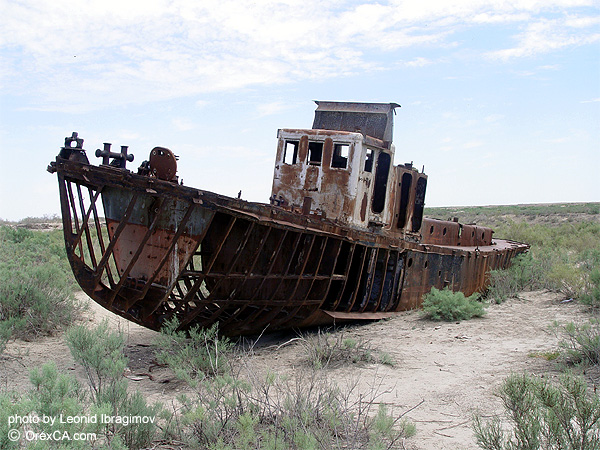
Nonetheless, I'm glad I went, though it's almost disappointing after all the infamous pictures. The ship cemetery has been decimated (eight hulks to four) by locals cutting up the remains for scrap metal--you can hardly blame them for exploiting such a tragic situation, but it's sad to lose what is essentially a monument to the absurdity of environmental manipulation. The former seabed, as far as we got (45 km from town) could almost be described as verdant, far from the desiccated salt pan I was expecting--this exists, but it's farther out. And the new fishing harbor proves that there is indeed water not all that far from town, albeit shallow and muddy and brackish. The "good" news is that if you didn't know where you were, you'd never guess all the destruction that's gone on. I traipsed around merrily taking pictures of the ship hulks for at least fifteen minutes before I noticed that the strange crunching sound underfoot was not brush but seashells.

I would like to have seen the dike, and the cliff where the former sea got deep, and the salt flats that have replaced it. Oh well: at least I saw something, in what was, logistically speaking, one of the wildest travel stunts I've ever pulled. The whole excursion, about 18 hours from arrival to departure on train, cost $200-400 (hotel, driver and guide, food, extra train ticket and conductor's "tip"), enough to survive for nearly a week in most places I go. How odd that one should pay such a high premium to visit what Sergei, the eagle-trainer in Almaty, described as "a kind of hell." I think this bespeaks a paradox of travel in general: the most popular spots are over-priced, but so, often, are the least popular, because they don't even have the infrastructure to support what few tourists they might receive.

Aralsk is in many ways the most bizarre, fascinating place I've visited on this entire trip, and I urge readers to get "google-y" on it. (Notice, when you do, how out of date many of the pictures are, depicting huge intact ships run aground in sand. There are only pieces of ships left now, and the ground is heavily vegetated.) For me getting there was the fulfillment of an almost lifelong quest, dating back to when I first heard of it in the late '80s in Al Gore's book (not the recent, famous one, An Inconvenient Truth; the old, forgotten one, Earth in the Balance, which I suspect I'm the only person ever to have read) and thought, Surely it isn't possible to destroy a sea! It seemed so far away and exotic, I all but dismissed it. But around the same time I read The End of Nature by Bill McKibben, in which he argues that the fundamental environmental crisis is not scientific or political or economic, but philosophical: humans simply can't fathom that things like the sky and the oceans are finite, and can be--and have been--significantly altered by their own activities. There are many who would pillory McKibben, and Gore, and any serious concern for the environment, but when you drive for an hour through the desert that used to be a seabed, their case seems pretty ironclad.

Visiting Aralsk also gained a particular significance for me because earlier in the trip I'd swum in the Amu-Darya, one of the two rivers diverted to drain the Aral Sea, and seen bales of cotton for sale on the street in Fergana, and eaten fish from smaller lakes that used to come from the Aral.

Saved by beer again!


MOSCOW, RUSSIA

This is a complicated story, and one that you may need to be a traveler to appreciate, so bear with me...

I've already said that the beauty of Russian/former-USSR trains is the stops, where women young and old descend to sell everything a weary traveler might want, from bliny to beer. The ugliness is Customs, which, due to the vicissitudes of Stalinist borders, we had to go through four times (count 'em!) on this train (Aralsk, Kazakhstan to Moscow, Russia). I'd carefully stockpiled some Kazakh tenge from Almaty to cover food and drinks en route, but, since I hadn't been to Russia yet, I had nothing in the way of roubles. As the last border stop drew on and on, I began to worry about my ability to feed myself, as we were forbidden to leave the train, and would soon be out of Kazakhstan. Finally, after the Customs officers had removed ceiling panels and unpacked bags and brought in dogs, and the Immigration folks had had their way with our passports, we were allowed, after nearly two hours, ten minutes of freedom on the platform.

Gleefully, I descended, pouncing on the first food--dumplings--I could find, hesitant to pay in Kazakh tenge now that we were in Russia, but the saleslady accepted my Kazakh note and gave change in roubles. I moved on to another seller with another note to purchase beer. Again, a successful transaction with change in roubles. Once more I tried for mineral water: success and Russian change once more. If I could just buy one more thing, I thought, I could get rid of all my Kazakh money and have enough roubles to last me till Moscow. So I went to yet another vendor and bought another beer. She was a bit put off by my large Kazakh bill, but she agreed, and, under the supervision of several young Kazakh men, issued me the "correct" change in roubles.

I never did see the moneychanger I'd been hoping for, but who cares? I now had more delectable dumplings than I could eat, more beer and mineral water than I could drink, and more roubles than I could spend, all without ever so much as touching an ATM card or trading currencies.

I had one Kazakh and one Russian beer, by the way: neither was great. But the dumplings were a gourmet experience--so fresh and hot they melted together in the plastic bag the lady dispensed them in. Just beef and onion and dough, but magic occurs with the labor of assembly.

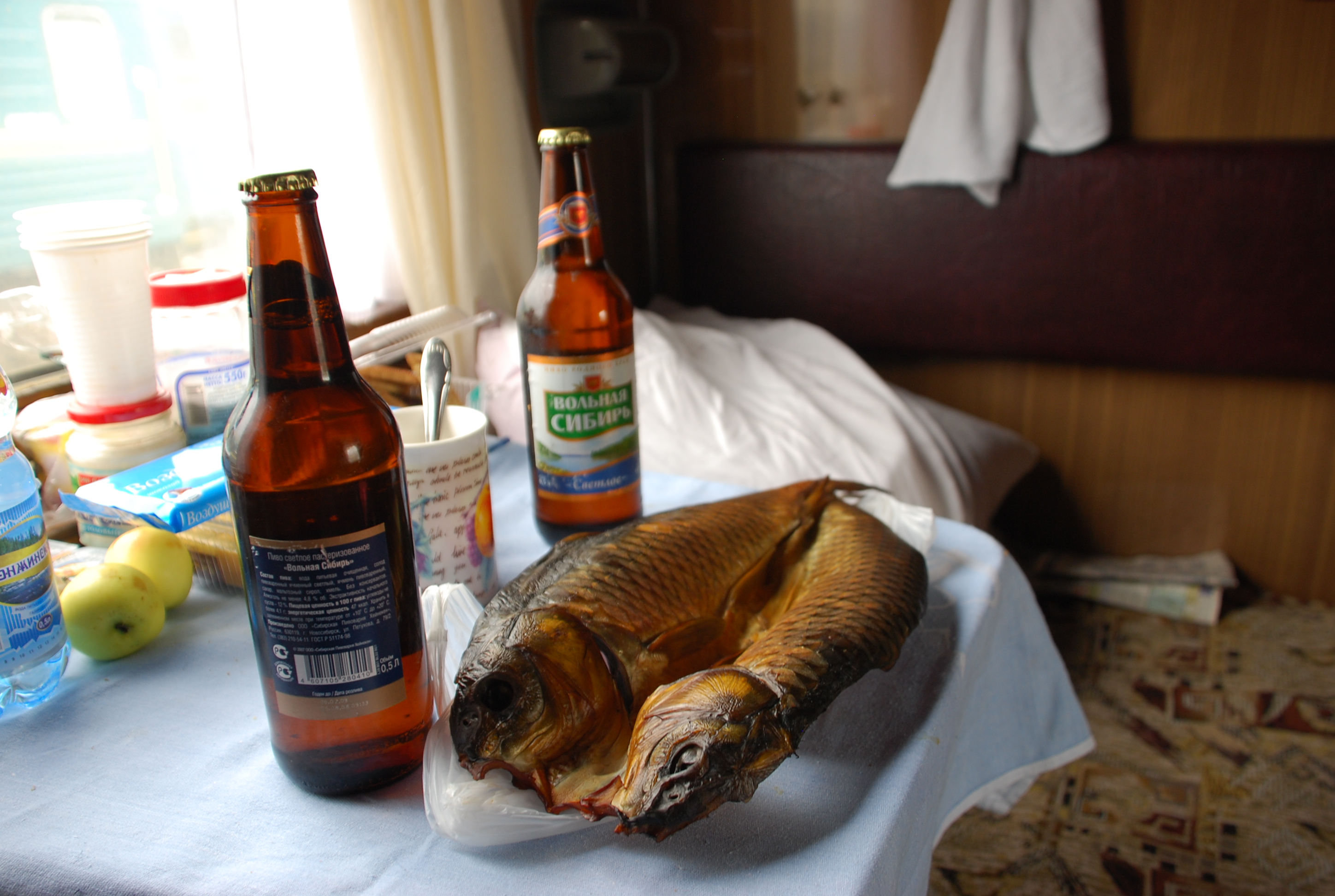
Note on photo-verisimilitude: I'd tried the fish earlier--I felt I had to, since little old ladies push it on you at nearly every stop. In a nutshell: I'm glad I had beer to wash it down.

Saturday, August 22, 2009

Whole lot of nothing (Aralsk)


ARALSK, KAZAKHSTAN

Incredibly, they have Internet here--about the only thing they do have. The guy in the Internet cafe couldn't believe I was American; prob. he'd never seen one before. The guy who sold me my train ticket said it's the first one he'd ever issued. Suffice it to say this is not a hot spot. Rather, it's one of those places you go to for everything it lacks: most importantly, what used to be the world's largest lake(?), depending on how you count lakes, seas, continental rifts, area vs. volume, salt vs. fresh, etc. Now, thanks to Kruschev's ingenious scheme to make Kazakhstan a cotton superpower by diverting the Amu-Darya and Su-Darya, two gigantic rivers that drain the Pamirs (cousins of the Himalayas), it's one of the world's largest salt flats--laced with all sorts of toxic chemicals distilled out of the water and the secret Soviet weapons lab, and fertilizer for all that cotton.

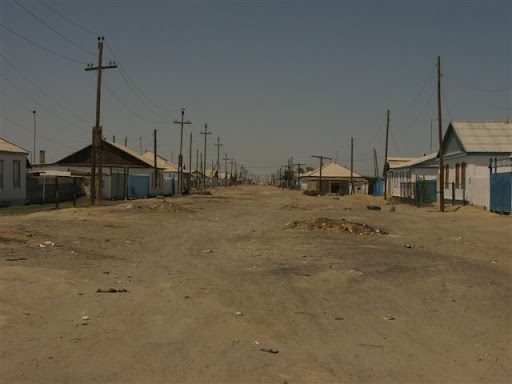
So what's it like? I haven't been to where the photo was taken yet, so I'll describe the town itself: broken beer bottles pave the streets, camels roam like stray dogs, once-decorative wooden houses threaten collapse and newer ones are cobbled together from scrap metal, ill-clad children wander seemingly unsupervised. The air quality is a lot better than I expected, but then, there's been no wind yet. I'm finessing dinner because I can't really find anywhere to eat. (That's partly because a wedding has taken over the largest, perhaps only, restaurant.)

Keep your fingers crossed that I get out of here tomorrow. Since you're not allowed to buy a train ticket out of Aralsk in advance for some reason, and demand is way high, I've bought two separate tickets: one to get here, from Tashkent, that I just used; a second, from Almaty (Kaz) to Moscow that I intend to use a portion of (Aralsk to Moscow). I've had to contract someone in Almaty to pay the conductor there not to give away my berth between Almaty and here. Oh, the wonders of the post-Soviet world! I haven't heard that the scheme failed, so I'm cautiously optimistic. Aralsk is an interesting place to visit, but I'd hate to get stuck here.

Friday, August 21, 2009

Standing on the last leg

TASHKENT, UZBEKISTAN

The 'stan tour officially ended this morning, so I'm on my own again. By my count (and geographically), that means the trip is 2/3 over, even though five out of six weeks are done. The three "legs" are as follows:
  1. Beijing to Almaty (Kazakhstan)--2 weeks, independent (train)
  2. Bishkek (Kyrgyzstan) to Tashkent (Uzbekistan) via Kashgar (China), Fergana Valley, Tajikistan, Samarkand, Bukhara, Khiva--3 weeks, with 7 Brits and Aussies, Brit/Aussie guide, drivers, support staff (zill, horse, minibus, taxi, jeep)
  3. Tashkent to Moscow (via Aralsk)--1 week, independent (train)
I'm off to the station as soon as I finish this, via the stunning Soviet-built metro. (Yes, the Soviets did a few things well, and subways are a shining example.) Wish me well as I resort to all kinds of finagling to ensure I get in and out of Aralsk (former Aral Sea port in Kazakhstan) on time--more on the machinations later.